Muistutetaan heti alkuun: olen näiden kaiuttimien maahantuoja. Tästä syystä tekstini saattaa olla puolueellinen. Siltä se tulee...
Let’s get this out of the way right at the start: I’m selling these speakers. For that reason my text may be biased. And it certainly is going to come across that way, because I have no alternatives but to praise these speakers quite a lot!
Ubsound F85 simple, not cheap
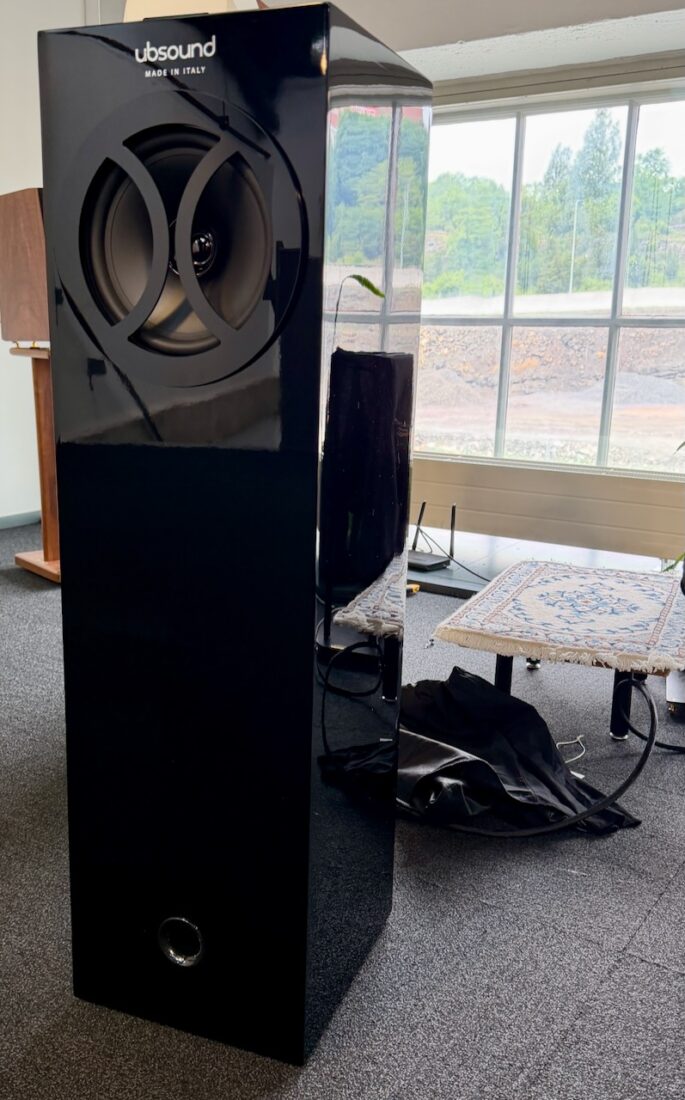
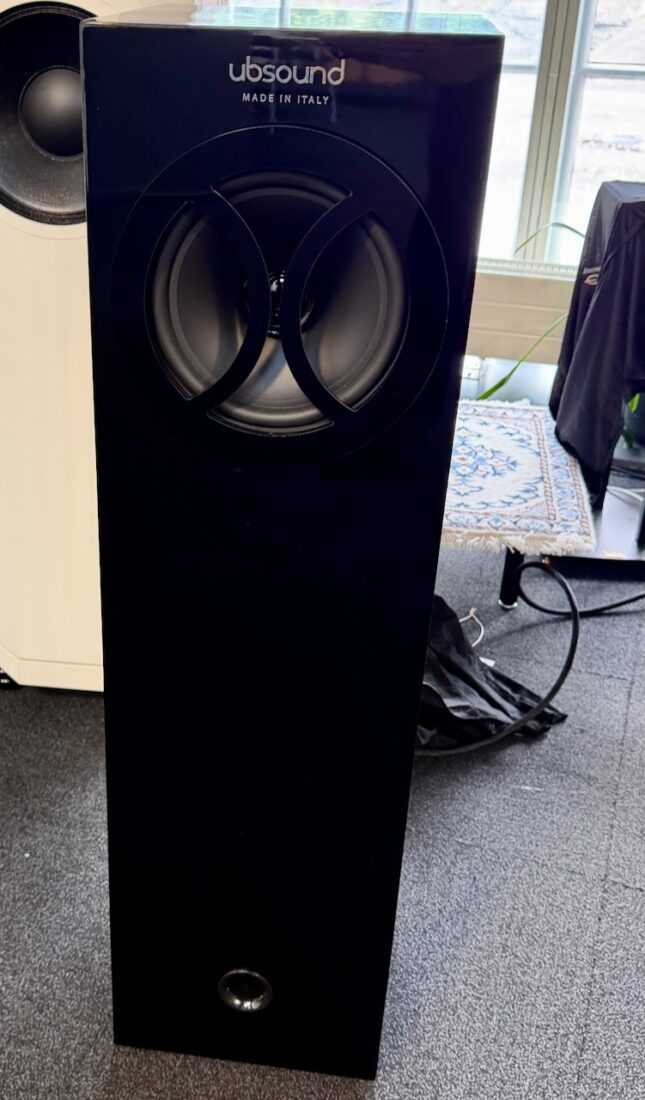
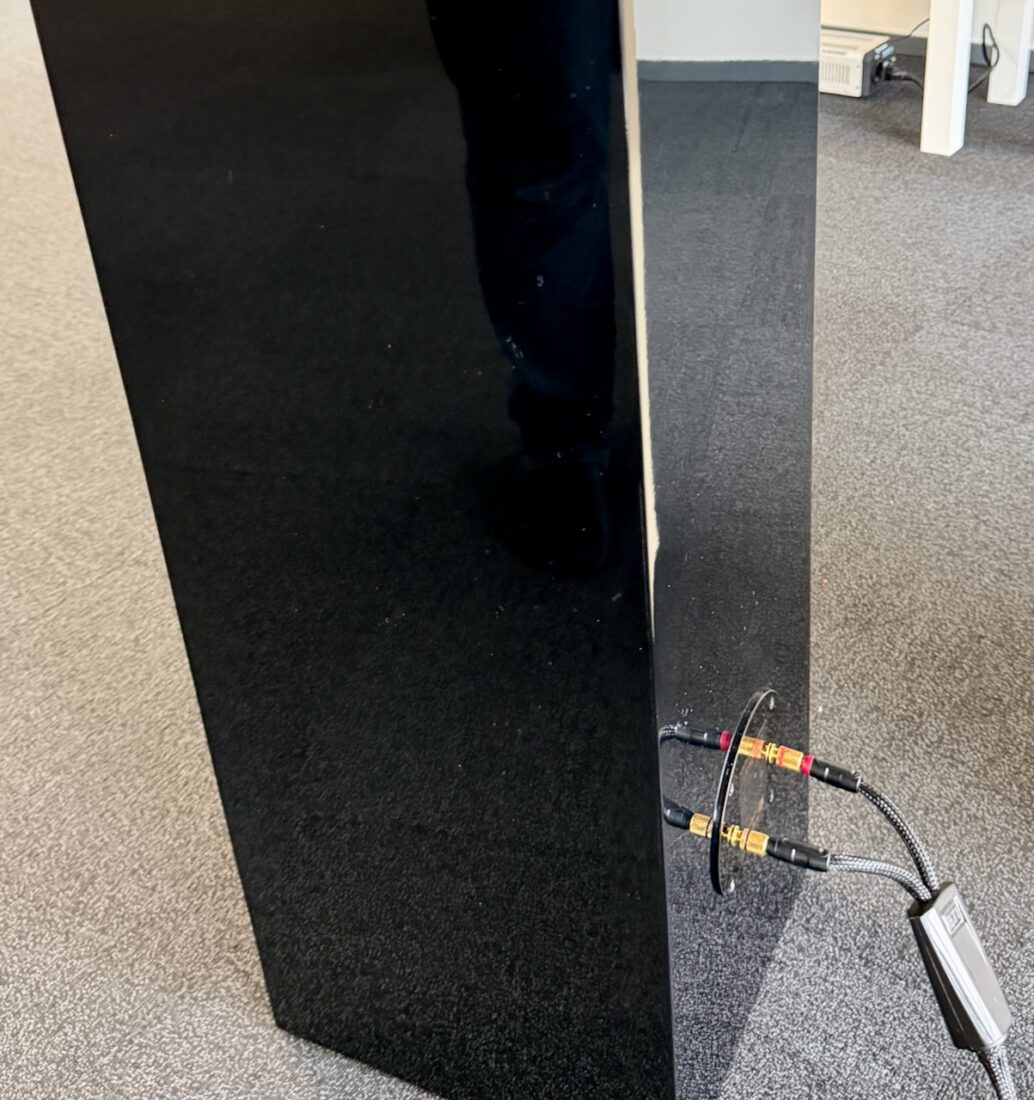
The Ubsound F85 is a smallish floorstanding speaker with a single connection terminal, a bass-reflex port, a piano-lacquered (automotive paint) finish, and one driver. Nothing else. Measured by component count, it’s a fairly simple construction. At the same time, the price of the speaker alone places it squarely in the High End region. You can tell as much from the list above, but let’s say it aloud once more: the speaker has no crossover.
The manufacturer emphasizes the uniqueness of that single driver as well as the cabinet’s resonance-free design. The speaker’s finish, and especially the paint surface, is excellent to my eye — in fact the best I’ve seen. A pared-down appearance can read as ”cheap” to some, but personally I find the look successful, if very minimalist.
Sound politics issued
But what mainly interests me is just the sound. The approach is, admittedly, bold. The speaker is given some pretty wild performance figures, even though the sensitivity (90 dB/W), for example, isn’t anything remarkable. The frequency response is claimed to reach from 26 Hz all the way up to 22 kHz. Quite a wild promise, in my opinion.
But, speakers into the showroom — they ended up a bit too far from the back wall, but otherwise reasonably placed. Then on to listening; UH!
Right from the immediate sound you notice that I’ve never heard anything like this from any passive speaker. The sound isn’t an image or a copy of the original — it seems exactly like the original itself. The age-old cliché is that a veil is lifted from in front of the speaker and the real performance comes through. Now nothing is lifted; instead, the original performance enters the room, whatever that happens to mean. The sense of presence extends from the soundstage to the timbre of the sound, and especially to the attack and decay of the sound. I haven’t heard anything like this before.
Sound with samples
For example, that always-used Suzanne Vega track, Tom’s Diner. Usually attention goes to the echoes and small background noises. But not now. Attention is first drawn to how, in the soundstage, you can ”see” behind the singer. Vega stands in the middle of the soundstage and doesn’t block the rear of it. The singer is thus three-dimensional in a three-dimensional space. Usually, to my ear, the singer is two-dimensional in a three-dimensional space.
In many samples the speaker served up surprisingly dimensional bass. Organ music, for instance, often works really splendidly. On the other hand, a lot of ”boom” music remained a touch low on dynamics in the bass, such as Danger Zone from the film Top Gun. Then again, Queensrÿche’s ”Best I Can” from the Empire album worked perfectly well. With only a couple of exceptions, I was quite satisfied with the bass. As a reminder, again: from a single full-range driver I have never heard anywhere near this kind of high-quality and dimensional bass. The other end of the frequency range was an even bigger surprise. All the full-range drivers I’ve heard have somehow been muffled at the very top of the treble. But not this one! Everything needed comes out of the treble, articulating astonishingly clearly and with good balance, too. I’m not overly fussy about absolute final neutrality in the frequency response, and age may limit my hearing range as well, but in any case I’m satisfied with the treble reproduction and, naturally, very positively surprised.
Classical music, and especially orchestral music, sounds wonderful. For example, the serene opening of the second movement of Tchaikovsky’s 5th Symphony, with its French horn solo, is real ear candy. The solo instruments sound in space, and the accompanying instruments stand out beautifully. The orchestra is relatively distant, but the position of the violins in depth, for instance, is positively really far from the percussionist, and the cellos from the trumpets. In drawing the orchestra’s instrument map, I don’t think I’ve heard a better performance.
Ubsound F85 concluded; the best and least bad at the same time?
Let me return to balance once more. It isn’t perfect. On balance alone, the best speakers with crossovers are better. The Ubsound F85 comes out a bit thin on the bass side, and the response is probably not ruler-flat in either the midrange or the treble. My own guess is that it comes down to whether the enormous sense of presence outweighs the smallish balance errors, or vice versa.
Compared with all the full-range speakers I’ve heard, the F85’s balance errors are small. The spatial and temporal separation is, in my opinion, absolutely top-tier. In any case, these speakers simply should be heard before a purchase decision. In Finlad I’m offering that possibility. Proudly.